Feature

Glassman: Yang See and the Hidden Crossing at Nong Khai, May 1975

While Long Tieng emptied in May 1975, a Hmong development officer known by the code name Glassman crossed the Mekong with a few hundred people and opened the first unofficial refugee camp in Thailand. This is the story of those weeks, day by day, on a map drawn from real coordinates.

Nong Khai refugee camp, Thailand

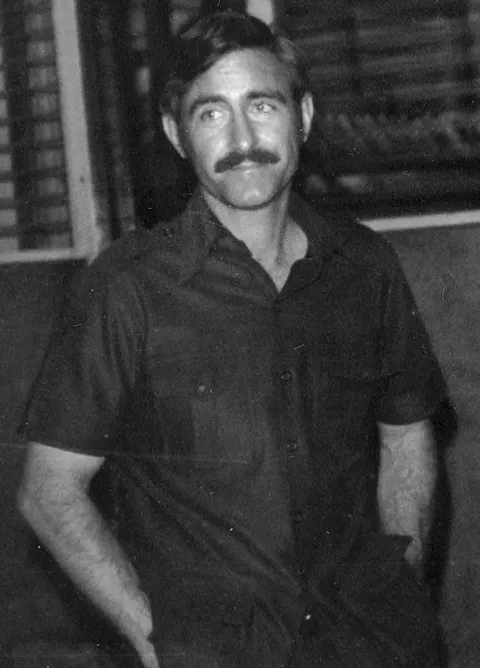
A man in the background

Most tellings of May 1975 follow the aircraft out of Long Tieng, the generals and the case officers. Another thread follows the people who walked or rode toward the Mekong and the Hmong staff officer who was waiting for them on the Thai bank (See, n.d., pp. 10–14). He was known as Glassman, the only man in the Clandestine Army who wore real white prescription glasses. His wife ran Glassman’s Lounge in Long Tieng, and he worked under Jerry Daniels as assistant on a one-million-dollar development program for laid-off Special Guerrilla Unit soldiers in Military Region 2 (See, n.d., pp. 5, 10).

When the Royal Lao positions collapsed, See asked Daniels whether the soldiers, widows and orphans could be flown out. Daniels told him the plan covered 2,500 people, mostly Vang Pao’s family and those Vang Pao authorized, and warned him about what waited on the other side of the river (See, n.d., pp. 8–9). See chose to go anyway. The log below follows him from his resignation on May 10 to a State Department Christmas party in Washington on December 23 (See, n.d., pp. 10, 41–42).

The weeks on the river

Larry Thompson’s Refugee Workers in the Indochina Exodus (2010), which anchors the feature on the Refugee Workers of Thailand, follows the exodus from Udorn, Bangkok and Washington. The Nong Khai weeks fill in the river side: a temple that sheltered a few hundred people by May 14, a governor who had already prepared for refugees, bus convoys to Nam Phong, an order to stop crossings, and a long argument over where the Hmong should be camped (See, n.d., pp. 12–35). The two accounts meet at several points, and the comparison table sets them side by side.

How the map works

The map is drawn from real coordinates, and each marker tells you whether it is a specific site, a town center or an approximate area. Distances are straight-line and computed, so a bus or boat journey was longer than the figure shown.

Interactive map

Where it happened, to scale

Pick any entry in the day-by-day log below, or use the slider, to see the places and routes for that day. Dashed circles mark approximate areas.

17°N18°N19°N101°E102°E103°ELAOSTHAILANDMEKONGPorter flight, May 10: 132 km in a straight lineRoute 13: Phou Khoun to Vientiane: 165 km in a straight lineVientiane to the Thadeua pier: 16 km in a straight lineBoat crossing to Thailand: 3 km in a straight lineTaxi convoy to Udorn, May 14: 52 km in a straight lineBuses to Nam Phong, May 21 and 25: 131 km in a straight lineTruck runs from Pak Chom: 92 km in a straight lineUdorn to Pua: Nan survey area: 279 km in a straight lineOverland trek from Hin Heup: 83 km in a straight lineVientianeUdon ThaniNanPhon PhisaiPak ChomChiang KhanPuaMae CharimPhou KhounHin HeupNam Ngum DamPhou Khao KhouayLong TiengThadeua crossingNong Khai · Wat SamakkhiSi Chiang MaiTha BoNam PhongBan Vinai100 kmN

Detail: the crossing between Vientiane and Nong Khai. The scale bar is 10 km, so you can see how close the two river banks are.

17.7°N17.8°N17.9°N18.0°N18.1°N102.4°E102.5°E102.6°E102.7°E102.8°E102.9°E103.0°ELAOSTHAILANDVientiane to the Thadeua pier: 16 km in a straight lineBoat crossing to Thailand: 3 km in a straight lineVientianeThadeua crossingNong Khai · Wat SamakkhiSi Chiang MaiTha Bo10 kmN

Choose a day

Select an entry

Use the slider or the log to move through May to December 1975.

Leaving LaosCrossingCamp transfersPolicy proposals

Measure any two places

Choose two places.

Great-circle distance on a sphere of radius 6,371 km, computed in your browser from the coordinates in the table below.

Distances by leg
LegStraight-lineWhat the account says
Porter flight, May 10132 kmYang See: the flight took 35 minutes
Route 13: Phou Khoun to Vientiane165 kmFighting at Sala Phou Khoun, the junction of Routes 13 and 7, was in the news while See was in Bangkok. The line shows the scale of the distance
Vientiane to the Thadeua pier16 kmYang See: the pier was 30 km from Vientiane
Boat crossing to Thailand3 kmLong-tail boats crossed from the Lao pier to the Thai side
Taxi convoy to Udorn, May 1452 kmYang See: six taxis passed three checkpoints on the way to Udorn
Buses to Nam Phong, May 21 and 25131 kmBuses left from Nong Khai, Tha Bo and Si Chiang Mai
Truck runs from Pak Chom92 kmYang See trucked up to about 1,000 refugees from Pak Chom and Chiang Khan to Nong Khai
Udorn to Pua: Nan survey area279 kmA July 1975 helicopter survey looked at sites in Nan province. The line shows the scale of the distance and is not the flight path
Overland trek from Hin Heup83 kmGroups walked from the Hin Heup bridge area toward the Mekong; the trail itself is not mapped here
Every coordinate and its source
PlaceLatitude, longitudeMarker meansSource
Long Tieng19.1095, 102.9223specific siteLima Sites dataset (LS30/LS98/LS20A)
Phou Khoun (Sala Phou Khoun)19.4400, 102.4300town or district centreTwo gazetteers agree on 19.44 N, 102.43 E
Vientiane17.9667, 102.6000town or district centreNatural Earth populated places
Thadeua crossing (Friendship Bridge area)17.8783, 102.7156approximate areaCoordinates of the First Thai–Lao Friendship Bridge (Wikipedia). The 1975 pier was nearby; its exact spot is not located
Nong Khai · Wat Samakkhi17.8733, 102.7479approximate areaNong Khai city centre (Natural Earth). Wat Samakkhi lay on the city outskirts; its exact site is not located
Si Chiang Mai17.9564, 102.5894town or district centreDistrict centre (Wikipedia)
Tha Bo17.8497, 102.5811town or district centreDistrict centre (Wikipedia)
Phon Phisai18.0219, 103.0772town or district centreDistrict centre (Wikipedia)
Udon Thani (Udorn)17.4048, 102.7893town or district centreNatural Earth populated places
Nam Phong16.7019, 102.8567town or district centreDistrict centre (Wikipedia)
Pak Chom18.0217, 101.8883town or district centreDistrict centre (Wikipedia)
Chiang Khan17.8981, 101.6664town or district centreDistrict centre (Wikipedia)
Ban Vinai17.9306, 101.9142specific siteCamp site coordinates (Wikipedia)
Hin Heup (Nam Lik bridge)18.6400, 102.3300approximate areaVillage-level coordinates from a gazetteer; accurate to roughly 10 km
Nam Ngum Dam18.5308, 102.5475specific siteWikipedia
Phou Khao Khouay (Buffalo Horn) range18.3819, 103.0997approximate areaCentre of the national park (Wikipedia); the range is long and this marks only its middle
Pua (Nan)19.1742, 100.9167town or district centreDistrict centre (Wikipedia)
Mae Charim (Nan)18.7033, 101.0050town or district centreDistrict centre (Wikipedia)
Nan18.7868, 100.7715town or district centreNatural Earth populated places

Borders for Laos and Thailand come from geoBoundaries (Runfola et al., 2020; CC BY 4.0), and the Mekong is drawn where it forms their shared border. The Vietnam outline comes from Natural Earth (n.d.; public domain). Projection: equirectangular, scaled at 18.1°N so east–west and north–south distances read true near the middle of the map.

Interactive

The day-by-day log

Open any entry for the detail, and use the chips to filter. Page numbers for See (n.d.) are PDF pages of the manuscript.

  1. In early 1975 the war in Laos had settled into an uneasy calm. A peace agreement was in place, the American training staff had gone home, and Jerry Daniels and his assistant Yang See were spending a one-million-dollar development budget on pilot farming projects in Military Region 2, with a plan to hand everything to USAID by the end of July (See, n.d., p. 5). Daniels had promised to help See study at the University of Montana in Missoula, and he suggested getting a hernia repaired in Bangkok, where surgery cost far less than in the United States. See and his wife traveled there on March 18 for about $1,000 (See, n.d., p. 5). Before the operation he had lunch with Larry Woodson, who handled Daniels’ cattle purchases for laid-off soldiers, and with Toufu Vang, General Vang Pao’s liaison officer and interpreter (See, n.d., p. 6). From his hospital bed he watched Thai television report the near collapse of South Vietnam and Cambodia, and the next night he heard about heavy fighting at Sala Phou Khoun, the junction of Highway 13 and Highway 7, where Hmong troops were trying to stop the Pathet Lao advance toward Vientiane (See, n.d., p. 6).

  2. General Vang Pao’s family and their belongings were flown to Thailand on May 7, and over the next days the airlift of his 2,500-person entourage began unevenly, with a single C-47 doing the work. The Pathet Lao victory at Sala Phou Khoun had sent tens of thousands of villagers toward the Long Tieng airstrip, and Daniels, looking at the crowds on the runway, kept sighing that someone had to tell these people to go home (See, n.d., p. 7). On the evening of May 8, See asked Daniels whether the United States might also take the Special Guerrilla Unit soldiers, their families, and the widows and orphans of fallen soldiers. Daniels answered that the policy covered 2,500 people, made up of Vang Pao’s family and anyone the general authorized (See, n.d., p. 8). See decided to resign and find a way across the Mekong for everyone else. Daniels objected strongly. He asked where food, shelter and medicine would come from, and he asked See never to blame the United States or the CIA to newspapers or agencies (See, n.d., p. 9). See spent that night turning the decision over, and he found encouragement in President Kennedy’s well-known line about asking what one can do for one’s country (See, n.d., p. 9). Thompson (2010) describes the same ceiling from the Embassy side: on May 8 Daniels proposed evacuating 2,500 Hmong from Long Tieng to Udorn, and two days later he asked for 3,500, mostly officers and their families (p. 55).

  3. At breakfast that morning See asked his wife to pack a small bag and to divide their savings in two (See, n.d., p. 10). At 8:00 a.m. on May 10 he resigned orally, telling Daniels he was going to Vientiane and Nong Khai to start an overland exodus for everyone outside the group of 2,500. Daniels warned him again about death, sickness and imprisonment, and repeated his prohibition against talking to reporters or foreign organizations (See, n.d., p. 10). Daniels also kept his promise to fly See’s wife and young son to Thailand (See, n.d., p. 16). Pat McHugh flew See to Vientiane in 35 minutes, and See never returned to Long Tieng (See, n.d., p. 11). The two towns are about 131 km apart in a straight line. The same morning, General Vang Pao flew Dr. Yang Dao to Udorn (See, n.d., pp. 13–14).

  4. From the Vientiane airport See went straight to Nong Khai to find out whether any refugees had crossed. He found only a group of Thai Dam, whose leaders told him flatly that the Hmong could not share their camp and that he should speak to the governor (See, n.d., p. 11). On May 11 and May 12 he sat in Governor Khamphol Klinsukhon’s office all day without an appointment, until the governor’s secretary arranged one for May 13 at 11:00 a.m. (See, n.d., p. 11). The meeting lasted ten minutes. The governor already understood the refugees’ situation. The week before, he had met his staff, the mayors and the immigration police chiefs along the border and asked them to shelter Laotian refugees temporarily (See, n.d., p. 12). He sent an aide to show See possible sites, and See chose Wat Samakkhi on the edge of Nong Khai. After about a day of paperwork it became the first unofficial refugee camp in Thailand (See, n.d., p. 12).

  5. That evening See made radio contact with Daniels from General Vang Pao’s house in the Nahaidiao district of Vientiane. Daniels told him that everything was finished in Long Tieng, that he and Vang Pao would fly to Thailand the next day at an unspecified time, and that See should not use the radio to reach him again. The two men, Daniels said, were caring for the same people through two separate programs, and he would help See in a personal capacity if trouble came (See, n.d., p. 12). Thompson (2010) tells how the departure itself went. Daniels arranged a helicopter on a ridge above the airstrip, Vang Pao was driven there by jeep, and the Pathet Lao battalion walked into Long Tieng the next day (p. 58). Before leaving the house at about 7:30 p.m., See asked Tou Vang, who commanded the household security unit, to lead the family, guards, cooks and their families across the Mekong (See, n.d., p. 12).

  6. The night of May 13 began at the Student Center in the Simuang district of Vientiane, known in French as the Foyer Simuang, on the highway south to the Thadeua pier. See had promised the leaders, who knew him from his own school years and from the time he taught there, that their group of about 200 students would cross first (See, n.d., p. 13). After midnight he went on to Dr. Yang Dao’s house, where the family was waiting to join Dr. Yang Dao in Udorn (See, n.d., p. 13). The first Hmong group crossed between 4:00 and 5:00 a.m. on May 14. Between 5:30 and 6:00 a.m. Yang Dao’s family reached the embarkation point, about 700 meters past the main Laotian pier, where four long-tail boats were waiting. The propeller of the third boat tangled in a fishing net, and the boat drifted more than 750 meters downstream before the driver cleared it (See, n.d., p. 14). No police were on duty at the Thai pier yet. See settled the family in a small motel where he had rented four rooms, checked that the student groups had reached Wat Samakkhi safely, and waited for the Thai immigration police, who arrived at 8:00 a.m. and registered the refugees family by family while he interpreted for two hours (See, n.d., p. 14). At about 10:30 a.m. he hired six taxis for 1,200 baht each, paid by Yang Dao’s older brother Gnia Toua Yang. Three checkpoints lay on the road to Udorn, and the strictest was at Nong Song Hong, just outside Nong Khai. See rode in the lead taxi and handed over 2,500 baht at the first checkpoint and about 5,500 baht in all, from his own pocket (See, n.d., p. 15). The family rested that evening at Colonel Thao Cai’s house in Udorn (See, n.d., p. 15). The manuscript gives the distance from Vientiane to the Thadeua pier as 30 km (See, n.d., p. 13). A straight line from the Friendship Bridge, which stands near the old pier, measures about 16 km on the map.

  7. On May 15 See and Pa Nou Thao, General Vang Pao’s chief cook, rented a large truck to bring Pa Nou Thao’s family and See’s own family down from the Long Tieng area (See, n.d., p. 15). Back at Wat Samakkhi, See found students who had left their parents behind and had no food or shelter. He spent the savings he had set aside for schooling in the United States on rice, canned fish, condensed milk, black plastic sheeting, mosquito coils, charcoal, cooking pots, quinine and other first-aid medicines (See, n.d., p. 16). On May 16 he met two Thai friends who had worked in construction and maintenance for the CIA at Long Tieng, and they agreed to help move about 300 people. Together they arranged fifteen long-tail boats at 15,000 kip per boat per trip, about five dollars, with each boat carrying 10 to 12 people (See, n.d., p. 16). The Laotian immigration chief at the Thadeua pier asked for 2 million kip to let the group go, and the organizers decided to take the risk without paying. A group of 315 people needed at least 51 taxis, each carrying up to six passengers (See, n.d., p. 16). At 4:00 a.m. on May 17 the taxis began arriving from the Morning Market, one Thai friend led the convoy to the boats, and See handed over 600,000 kip for the boats. The whole operation cost 1,365,000 kip, about $455 (See, n.d., p. 17). Only the Thai immigration police, who came at 9:00 a.m. for their daily registration, knew about it (See, n.d., p. 17). In the following two or three days the Nong Khai population rose from 500 to 2,500 and kept growing (See, n.d., p. 17). About 90 percent of the supplies in those first weeks were bought with See’s own money, and the local chapter of the Society of Saint Vincent de Paul made occasional visits (See, n.d., p. 21). The governor never visited the camp, and See, who feared deportation, dealt with Thai officials humbly and with great care (See, n.d., p. 22).

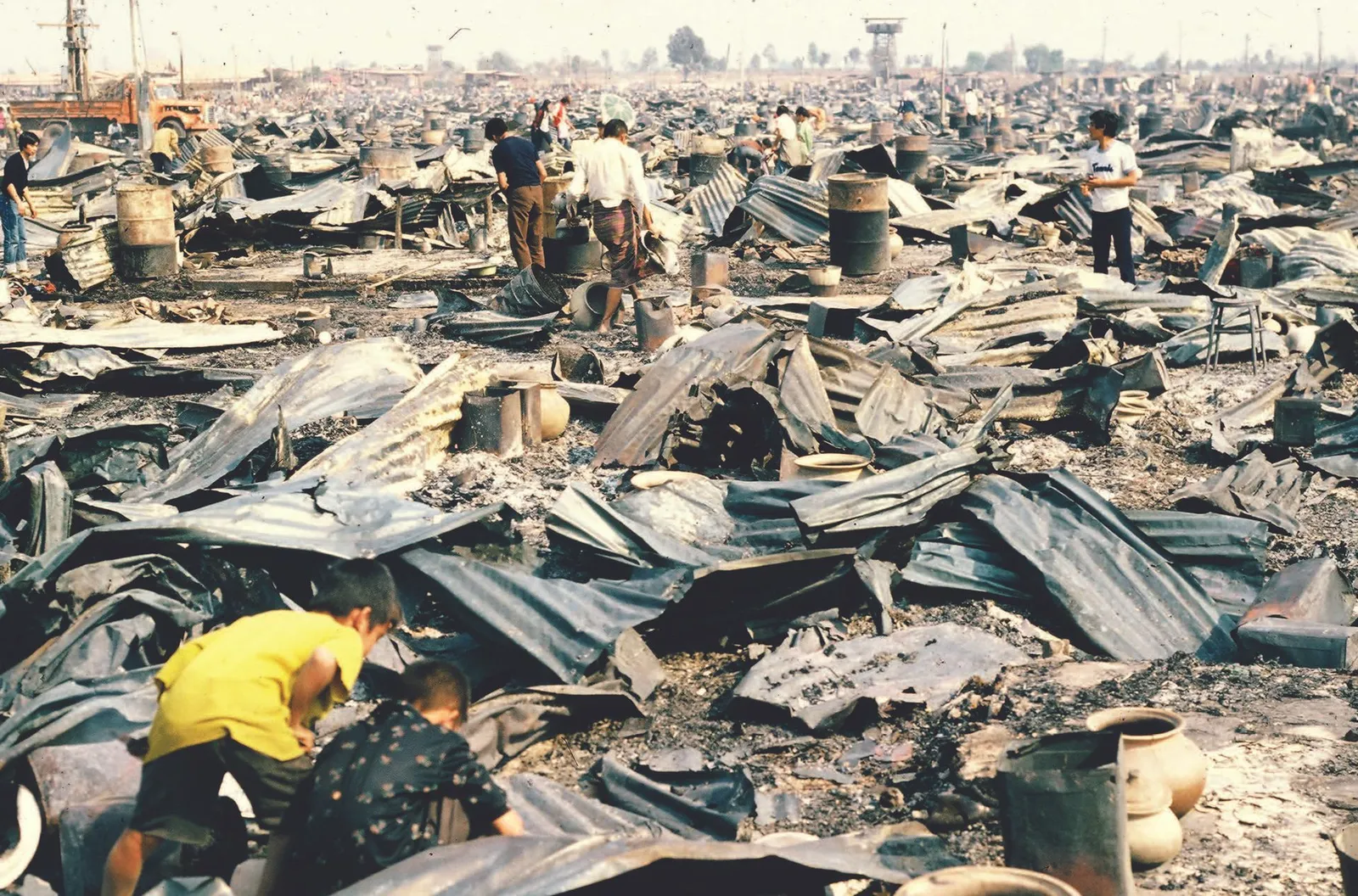
  8. By May 18, the fourth day of the surge, the temple grounds were overcrowded. Sanitation was breaking down, with human waste around the temple buildings and a real fear that the new wells would be contaminated, so See looked to move people to Nam Phong, where the American quota of 2,500 had not been filled (See, n.d., pp. 21–22). That afternoon Daniels sent a driver with 10,000 baht, See’s pay for April and May. See wrote back asking him to take refugees from Nong Khai to Nam Phong and described two more concentrations, about 1,200 people at Tha Bo and about 1,000 at Si Chiang Mai (See, n.d., p. 23). On May 20 Daniels replied that the United States would take 1,500 people from Nong Khai to Nam Phong on the evening of May 21, in 25 buses led by Thai SOD staff from Headquarters 33 in Udorn (See, n.d., pp. 23–24). The same letter scolded See for an exchange on May 19, when a French priest and teacher, Daniel Taillez, visited from Vientiane and asked who was responsible for the camp. See had told him to ask at the U.S. Embassy, and the Embassy then telephoned Daniels’ superiors (See, n.d., p. 24). Daniels also wanted intelligence about Pathet Lao activity from newly arrived refugees and sent See a manual typewriter, so See rented a room at the Prachack Bungalow to write reports (See, n.d., pp. 24–25). Apart from the recognized camp at Nam Phong, the central Thai government did not learn about the border camps until near the end of the year (See, n.d., p. 22).

  9. On the morning of May 24 Daniels’ messenger delivered a letter promising 45 buses at sunset the next day: eleven for the first 679 people registered at Si Chiang Mai, fifteen for 912 at Tha Bo, and nineteen for 1,100 at Nong Khai (See, n.d., p. 25). On May 25 See took a taxi to Tha Bo and Si Chiang Mai to tell the refugees to line up in registration order, so nobody would argue about who went first, and he gave the same instruction to the local Thai supervisor (See, n.d., p. 25). The convoy was planned for 2,691 people. Together with the 1,500 who left on May 21, the two operations come to 4,191 people. The transfers eased the pressure at the border and made room for new arrivals (See, n.d., p. 25). A straight line from Nong Khai to Nam Phong measures about 131 km on the map, and the road is longer.

  10. At 6:30 p.m. on May 27 a driver took See to Daniels’ office in the former CIA compound called JLD in Udorn, their first meeting in 17 days (See, n.d., p. 25). Daniels told him that the new American and Thai orders did not mention deporting people already on Thai soil. They did say that any group crossing from May 29 on would be sent back to Laos (See, n.d., p. 26). Daniels believed that Colonel Saen had gone to Nam Phong to inform General Vang Pao, and he asked See to switch from helping people cross to discouraging new crossings. See answered with a hesitant yes, because he could never send back a group he knew had just crossed (See, n.d., p. 27). The two men discussed other matters as well. About 515 million kip collected from refugees at Nam Phong could not be exchanged for baht, since no bank in Thailand would take it and only a few middlemen along the border would accept small amounts, so See asked to use some of it to buy food for the border camps (See, n.d., pp. 27–28). Because See was barred from contacting foreign agencies, he asked Daniels to approach UNHCR on his behalf. Daniels asked See to move to Udorn as a part-time liaison to the Hmong leadership at Nam Phong (See, n.d., p. 26).

  11. By late May or early June the Thai government wanted the Lao ministers and generals hiding in Thailand to move on to third countries, and the Americans arranged General Vang Pao’s exit (See, n.d., p. 28). Thompson (2010) gives June 18, 1975 as the day he left Thailand, with Daniels taking him to Missoula, Montana, where he bought a 402-acre ranch (p. 61). The manuscript dates his departure from Nam Phong for Bangkok to “Tuesday, May 17,” which was a Saturday in 1975, and Tuesday, June 17 would fit Thompson’s date (See, n.d., p. 28). The Thai Ministry of Defense also wanted the Hmong out of Nam Phong, an active military training camp. On July 2 General Thone provided a helicopter to carry Thai Interior officials and Hmong leaders west toward Nan Province. The Hmong team was Colonel Ly Tou Pao, the new camp president, Colonel Tou Long Yang and Colonel Shoua Yang. The next day General Niem led them to see sites in western Nan with Colonel Saen and Bill Lair, who represented the Americans. After two days of flying they said no to every site, because the land was too poor for farming (See, n.d., p. 29).

  12. At 9:00 a.m. on August 27, Thai officials from the Ministries of Defense and Interior met twelve Hmong leaders from Nam Phong at the Charoen Hotel in Udorn, with a delegation from Bangkok led by General Niem. Daniels attended, and See came as his colleague and interpreter (See, n.d., p. 29). General Niem set out an ultimatum with three points. The Hmong leaders had to move the refugees out of Nam Phong, they had to choose one of the sites already visited or be assigned one, and Cambodian, Vietnamese and Lao refugees, Hmong included, were expected to resettle in third countries (See, n.d., pp. 29–30). The Hmong leaders pictured a promised land with permanent farmland, and the Thai officials pictured temporary shelter until the refugees could go home (See, n.d., p. 30). See argued for consolidating all the camps (Nam Phong in Khon Kaen, Nong Khai, Tha Bo and Si Chiang Mai, and Sop Tuang, Mae Charim and Pua in Nan) so that every refugee would have equal status and UNHCR could look after them all (See, n.d., p. 30).

  13. Before the meeting See asked Daniels to arrange an appointment with General Thone. Daniels cared mainly that the refugees were fed wherever they went, and he set the meeting for Tuesday, September 2 at 10:00 a.m. (See, n.d., p. 31). See laid out a map of Thailand and the western Lao border in front of General Thone and Colonel Saen and argued for resettlement at Nong Khai, a camp with loose rules and no barbed wire, where Lao and Hmong lived together under the watch of the immigration police (See, n.d., pp. 31–32). Thone turned the idea down because Nong Khai was too close to Vientiane and would draw wave after wave of new arrivals (See, n.d., p. 32). See then asked for a camp at Pak Chom or Chiang Khan, two small districts of Loei Province on the Mekong, and preferred Pak Chom. He pointed out that repatriation would be simple, since people could be ferried back across the river to a wide stretch of farmland running toward the Nam Ngum dam (See, n.d., p. 32). Thone promised to send Colonel Saen to survey both places (See, n.d., p. 33). On September 11 Daniels reported that after the visit the Thai had chosen a site between the two towns, about two kilometers from the Mekong (See, n.d., p. 33), in Vinai village (See, n.d., p. 35). That site became Ban Vinai. On the map the two towns are about 27 km apart, and the Ban Vinai camp site lies between them.

  14. Thompson (2010) describes the first column of Hmong walking from Long Tieng toward Vientiane. At the bridge over the Nam Lik, Lao soldiers had stretched a rope barricade, an old man began to untie it, soldiers opened fire, and the survivors scattered. Some hired boats downstream and others took hidden trails toward Thailand (p. 59). The manuscript places the shooting at the Hin Heup bridge near Hoei Mo village, about 100 km north of Vientiane, on May 25 (See, n.d., p. 18) and gives May 28 elsewhere (See, n.d., p. 33). After that the bridge was closed to groups of fleeing people, and they climbed Phou Khao Khouay, the Buffalo Horn Mountain ridge that runs south for about 80 km along the Mekong from the Nam Ngum dam. Reaching the summit took five days to a week of hard walking (See, n.d., p. 33). Refugees named one pass the “Saddle of Death.” Exhaustion, hunger and thirst killed members of many groups, some walkers’ feet rotted from the miles, small children were lost to suffocation while parents tried to keep a group quiet, and bandits robbed and killed some groups (See, n.d., pp. 33–34). Many groups stopped at the village of Ban Phra That Phonsan, with its tall stone stupa modeled on That Luang, across the river from the Thai district of Phonphisai (See, n.d., p. 34). Groups bound for Pak Chom and Chiang Khan walked from Hin Heup along a muddy logging road of about 15 km and then a trail to the river, and they avoided the patrols around Vientiane (See, n.d., pp. 34–35). Between May and September See made three trips to Pak Chom and Chiang Khan to pick up as many as 1,000 refugees and truck them to Nong Khai. About half had fled from Phou Gner in Luang Prabang Province, and the rest from Xieng Khouang and Sam Neua (See, n.d., p. 34). On the map, Hin Heup lies about 83 km from Pak Chom in a straight line.

  15. On October 25, 1975 Daniels came to the Red Horse bungalow that he had rented for See and a support team and asked See to go to the United States and represent the refugees (See, n.d., p. 38). See hesitated, because leaving would silence the people at the border and because no word had come that the United Nations would take over. He proposed that five Hmong families, and five Lao families chosen by Mac Thompson and John Tucker, send their biographies to the State Department so it could pick a family to represent refugees in Thailand (See, n.d., pp. 38–39). None qualified. Daniels then told him that UNHCR would soon contact him about taking over, and that going to America remained the best way to keep helping (See, n.d., p. 39). In the same weeks See flew with Daniels in an Air America Porter to the Hmong camp at Pua, where the airstrip was half underwater but the pilot landed safely, and then circled over Mae Charim and Sop Tuang, which trucks could no longer reach because of rain and landslides (See, n.d., pp. 39–40). Two young Swiss representatives of UNHCR met See at the Udorn Hotel at 9:00 a.m. after Daniels booked him a room, and they spent about three hours on the history of refugees in Thailand, living conditions and shortages (See, n.d., p. 40). Missionaries who had approached him over the previous five months had addressed him as Dr. Yang See (See, n.d., p. 40).

  16. At 11:00 p.m. on November 23 the family boarded a Sabena flight through Athens and Belgium to New York, then flew on to Washington, arriving at 1:00 a.m. on November 24 (See, n.d., pp. 40–41). Dr. Westmayer, a former diplomat in Vientiane, and Peter Knecht and his wife met them. A group of State Department employees had contributed money for the trip, and the group included Deputy Secretary Robert Ingersoll, the department’s number two official (See, n.d., p. 41). See went to the department twice in December and waited all day each time. On December 23, during the group’s Christmas party, Knecht called him to the Deputy Secretary’s office at 3:00 p.m. (See, n.d., p. 41). Ingersoll told him that Congress was in recess, that he would speak to Congress in January, and that he was confident funding for the refugees would come no later than April 1976 (See, n.d., p. 42). In April See heard that host-country workers who had served the U.S. government had started coming in (See, n.d., p. 42). Earlier efforts to send a Hmong representative had come up short. On June 27 Daniels proposed that See go to America and press Vang Pao to lobby the Ford administration and Congress (See, n.d., pp. 35–36). See chose Dr. Yang Dao, who traveled to Bangkok on June 29 with 70,000 baht but was refused visas when he presented a Laotian passport (See, n.d., pp. 36–37). See then chose Moua Lia, who left on July 2 and spent about a month with Vang Pao in the United States, with almost no result (See, n.d., pp. 37–38).

Interactive

The numbers

Hover, tap or use the arrow keys on a bar for its value. Each chart has a data table underneath.

People bused to Nam Phong, May 19751,500 people left on May 21 in 25 buses, and 45 buses were arranged for May 25 (See, n.d., pp. 23–25). The four bars add up to 4,191 people.
View the data
By pickup point
Nong Khai, May 211,500
Nong Khai, May 251,100
Tha Bo, May 25912
Si Chiang Mai, May 25679
How far each leg is, in a straight lineGreat-circle distances between the plotted points. Roads, river bends and trails make real journeys longer. Coordinates are listed in the map section.
View the data
Straight-line km
Porter flight, May 10132
Route 13: Phou Khoun to Vientiane165
Vientiane to the Thadeua pier16
Taxi convoy to Udorn, May 1452
Buses to Nam Phong, May 21 and 25131
Truck runs from Pak Chom92
Udorn to Pua: Nan survey area279
Overland trek from Hin Heup83
What things cost in May 1975
Crossing of the May 16–17 groupsAbout 1,365,000 kip, or about $455 (See, n.d., p. 17)
Each long-tail boat trip15,000 kip, or about $5 (See, n.d., p. 16)
Taxis on May 146 taxis at 1,200 baht each (See, n.d., p. 15)
Checkpoint payments on May 14About 5,500 baht in all, with 2,500 at the first (See, n.d., p. 15)
Fee asked at Thadeua2 million kip, not paid (See, n.d., p. 16)
Camp suppliesAbout 90 percent bought with See’s own money (See, n.d., p. 21)
Pay sent by Daniels10,000 baht, for April and May (See, n.d., p. 23)
Expenses for Dr. Yang Dao’s trip70,000 baht, or about $3,500 (See, n.d., p. 36)

Profiles

The people

Open a card for more.

Yang See (“Glassman”)

Hmong development officer and refugee camp organizer

Yang See was the only man in the Clandestine Army who wore real white prescription glasses, which gave him the code name Glassman. His wife ran Glassman’s Lounge in Long Tieng, where CIA case officers came for Chinese food and beer (See, n.d., p. 10). He worked under Jerry Daniels as assistant on a one-million-dollar development program in Military Region 2 (See, n.d., p. 5).

In May 1975 he resigned, crossed to Nong Khai, opened the first unofficial camp and spent the year arranging transfers and arguing for a permanent site. In November he flew to Washington (See, n.d., pp. 10–12, 40).

Read the full profile
Jerry Daniels

Jerry Daniels

CIA case officer; later refugee officer in Thailand

Daniels warned See against leading people out and asked him never to blame the United States for what followed (See, n.d., p. 9). Within days he sent See’s pay, arranged the Nam Phong transfers and sat beside him in meetings with Thai generals (See, n.d., pp. 23–24, 29, 31). He flew See’s wife and son to Thailand as promised (See, n.d., p. 16).

Thompson (2010) tells how Daniels slipped General Vang Pao out of Long Tieng by helicopter (p. 58). The two men described their programs as separate and kept helping each other (See, n.d., p. 12).

Read the full profile
Dr. Yang DaoHmong scholar and community leader

General Vang Pao flew him to Udorn on May 10, and his family crossed at dawn on May 14 (See, n.d., pp. 13–14). In late June See chose him to carry the Hmong case to the United States. He went to Bangkok with 70,000 baht and was refused visas (See, n.d., pp. 36–37).

Encyclopedia entry
Toufu VangLiaison officer and interpreter for Vang Pao

Joined See and Larry Woodson for lunch in Bangkok in March 1975 (See, n.d., p. 6).

Tou VangCommander of the security unit at Vang Pao’s house

On May 13 See asked him to lead the household, the guards, the cooks and their families across the Mekong (See, n.d., p. 12).

Governor Khamphol KlinsukhonGovernor of Nong Khai

Met See for ten minutes on May 13, 1975 and approved a site at Wat Samakkhi. He had already asked his staff, the mayors and the immigration police chiefs to shelter Lao refugees temporarily (See, n.d., p. 12). He did not visit the camp (See, n.d., p. 22).

Pat McHughPilot

Flew See from Long Tieng to Vientiane on May 10 in a 35-minute flight (See, n.d., pp. 10–11).

Daniel TaillezFrench priest and teacher

Visited the Nong Khai camp from Vientiane on May 19, 1975 to see his former students (See, n.d., p. 24).

Bill LairCIA officer

Joined the July 1975 helicopter survey of Nan Province as the American representative (See, n.d., p. 29).

Encyclopedia entry
Moua LiaPrimary school inspector for Xieng Khouang

Chosen on July 1 to take Dr. Yang Dao’s place on the trip to the United States. He left on July 2 and spent about a month with Vang Pao (See, n.d., pp. 37–38).

Source check

Where the sources agree and differ

Thompson (2010) and See (n.d.) side by side where both cover the same event, plus dates that vary within the manuscript.

PointWhat the sources sayResultNote
When Vang Pao leftThe manuscript dates his departure from Nam Phong for Bangkok to “Tuesday, May 17” (See, n.d., p. 28). Thompson (2010) gives June 18, 1975 for his departure from Thailand (p. 61).DiffersMay 17, 1975 was a Saturday. Tuesday, June 17 would sit one day before Thompson’s date.
The 2,500-person airlift planThe manuscript gives American policy as 2,500 people, mostly Vang Pao’s family and those he authorized (See, n.d., p. 8). Thompson (2010) has Daniels proposing 2,500 on May 8 and 3,500 two days later (p. 55).AgreesBoth describe a ceiling set by the Embassy and the CIA, with the later figure higher.
Where the Nan survey took placeThe manuscript calls the survey area western Nan Province (See, n.d., p. 29) and later lists camps at Sop Tuang, Mae Charim and Pua (See, n.d., p. 30).InternalPua and Mae Charim lie in central and eastern Nan. The map plots the places named.
Date of the Hin Heup shootingMay 25 (See, n.d., p. 18) and May 28 (See, n.d., p. 33). Thompson (2010) describes the Nam Lik bridge shooting without a date (p. 59).InternalBoth dates appear in refugee reports. The page shows the range.
Distance from Vientiane to the Thadeua pierThe manuscript gives 30 km (See, n.d., p. 13). On the map the Friendship Bridge lies about 16 km from Vientiane in a straight line.DiffersThe 1975 pier stood near the bridge. A road route through the city can run longer than a straight line.
Distance from Ban Vinai to the MekongThe manuscript gives about 2 km (See, n.d., p. 33). The camp site on the map lies about 12 km from the simplified river outline.DiffersThe outline simplifies the river, and the 1975 site may have differed from the later camp. The page shows both.
Order of the autumn eventsDaniels’ request is dated October 25 (See, n.d., p. 38), the reply with the ten-family result carries an October 12 date, and the flight to Nan is dated November 15 (See, n.d., p. 39). The hotel booking and the UNHCR meeting are dated October 19 and 20 (See, n.d., p. 40).InternalThe manuscript is unfinished. The dates are shown as written.

Encyclopedia

Related entries

Quick answers

Questions readers ask

Who was Yang See, or Glassman?

Yang See was a Hmong development officer who worked under CIA case officer Jerry Daniels in Military Region 2. The Americans gave him the code name Glassman because he was the only man in the Clandestine Army who wore real white prescription glasses (See, n.d., p. 10). In May 1975 he left Long Tieng, crossed the Mekong to Nong Khai, and opened the first unofficial refugee camp in Thailand (See, n.d., pp. 10–12).

What happened at Wat Samakkhi?

Nong Khai’s governor approved the temple grounds as a shelter on May 13, 1975 (See, n.d., p. 12). The first Hmong groups crossed on May 14, and from May 17 the camp grew from about 500 to about 2,500 people in two or three days (See, n.d., pp. 14, 17). Buses began moving people to Nam Phong on May 21 (See, n.d., pp. 23–24).

Why were the crossings ordered to stop?

On May 27, 1975 Daniels told See that the American and Thai governments wanted the influx stopped and that anyone crossing from May 29 on would be sent back to Laos. See agreed hesitantly (See, n.d., pp. 26–27).

How did Ban Vinai get its location?

See argued for Nong Khai, and General Thone ruled it out as too close to Vientiane. See then proposed Pak Chom or Chiang Khan, and on September 11, 1975 Daniels told him the Thai had chosen a site between them, near Vinai village (See, n.d., pp. 32–33, 35).

How did See get to Washington?

Daniels asked him in the fall of 1975 to go to the United States, and a group of State Department employees helped pay for the trip. He flew with his wife and son on November 23 and met Deputy Secretary Robert Ingersoll on December 23 (See, n.d., pp. 38, 40–42).

How was the map made?

Country borders come from geoBoundaries (Runfola et al., 2020) and Natural Earth data, and the Mekong is drawn along the Laos–Thailand border. Every point has a published coordinate, and a few markers are approximate, which the page states. All distances are straight lines computed from the coordinates.

References

References

  1. Natural Earth. (n.d.). Admin 0 – Countries [Data set]. https://www.naturalearthdata.com/
  2. Runfola, D., Anderson, A., Baier, H., Crittenden, M., Dowker, E., Fuhrig, S., Goodman, S., Grimsley, G., Layko, R., Melville, G., Mulder, M., Oberman, R., Panganiban, J., Peck, A., Seitz, L., Shea, S., Slevin, H., Youngerman, R., & Hobbs, L. (2020). geoBoundaries: A global database of political administrative boundaries. PLOS ONE, 15(4), Article e0231866. https://doi.org/10.1371/journal.pone.0231866
  3. See, Y. (n.d.). True story never told: How in imminent danger of losing their lives Lao and Hmong refugees fled en masse out of a relatively quiet Laos for safety in Thailand in May 1975 [Unpublished manuscript]. T-28 Trojan Foundation.
  4. Thompson, L. C. (2010). Refugee workers in the Indochina exodus, 1975–1982. McFarland.

Page numbers for See (n.d.) refer to the PDF pages of the manuscript. Place coordinates come from published gazetteer and encyclopedia entries, listed in full in the map section. The exact site of Wat Samakkhi and the position of Sop Tuang are not located on the map.

Hmongstory Legacy. (2026, November 17). Glassman: Yang See and the Hidden Crossing at Nong Khai, May 1975. https://hmongstorylegacy.com/glassman-yang-see-the-hidden-crossing-at-nong-khai-1975/

Related: Yang See profile, Refugee Camps, Refugee Workers of Thailand, Nong Khai, Ban Vinai, Nam Phong and Long Tieng.