Feature

The Refugee Workers of Thailand: How a Small Team Opened the Door for the Hmong

In May 1975 the United States left Laos with no plan for the Hmong who had fought beside its agents for fourteen years. A handful of refugee workers in Thailand set out to change that, one case file at a time. This feature follows their story, drawing on Larry Clinton Thompson’s 2010 book and its tables.

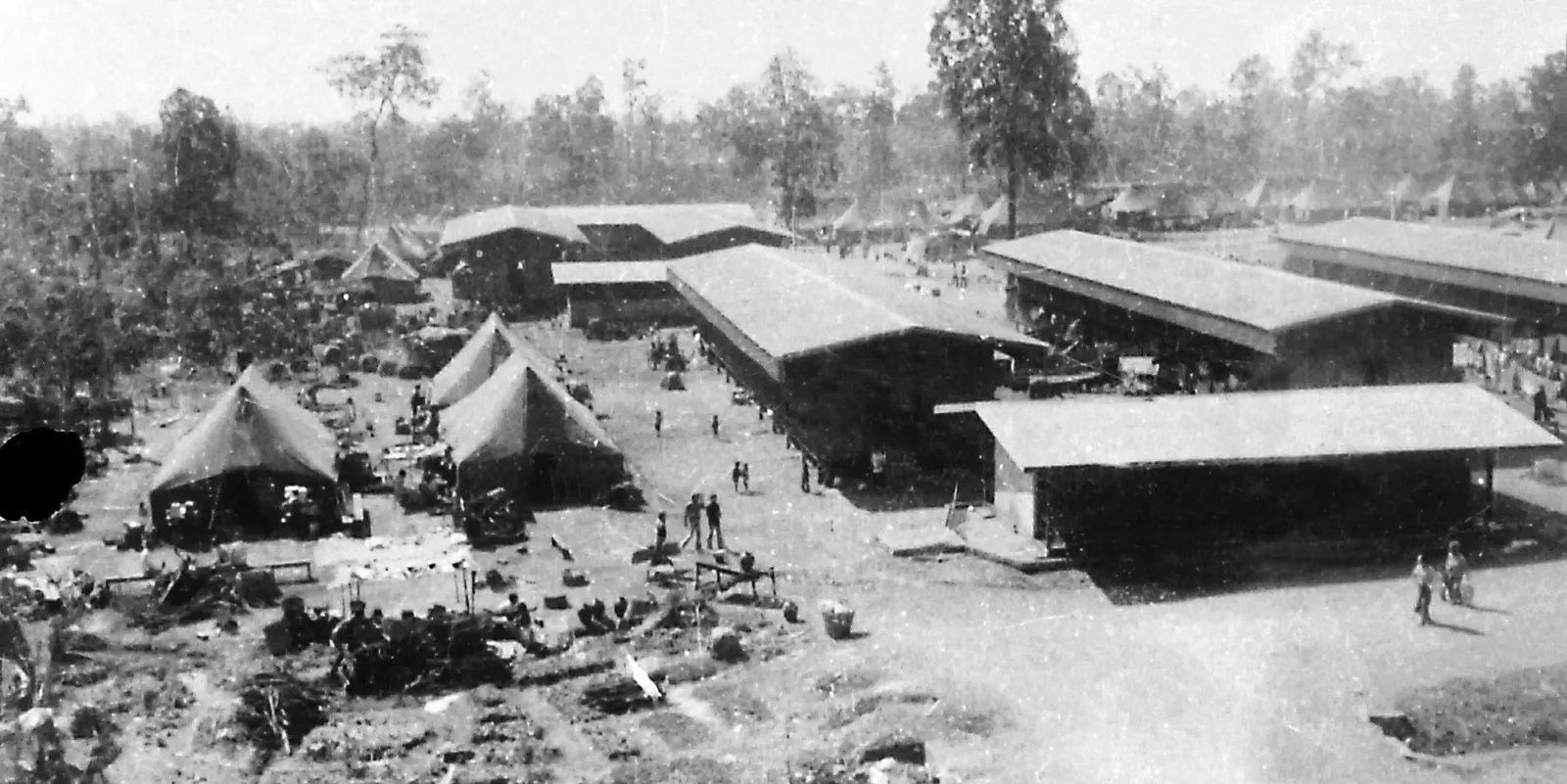
Aerial view of the Nam Phong refugee camp in Thailand

May 1975: the last days of Long Tieng

Long Tieng, Lima Site 20 Alternate, was General Vang Pao’s headquarters and one of the largest towns in Laos. It sat in a valley at about 3,100 feet, with a 4,200-foot runway and a limestone ridge at one end. At the corner of the runway stood the CIA compound, which Jerry Daniels had named “Sky” after his home state of Montana.

By the spring of 1975 the Hmong army was outnumbered and American air support had been ended by the 1973 agreements. On May 5, Prime Minister Souvanna Phouma called Vang Pao in and told him to cooperate with the communists. Vang Pao pulled the general’s stars from his collar, threw them on the floor and left the room. Daniels, who had been his case officer since 1965, told him the war could not go on, because the guns and ammunition he needed would not come.

Daniels asked the Embassy in Vientiane to fly out 2,500 people, then 3,500, mostly officers above the rank of captain and their families. The Embassy was busy preparing for a possible evacuation of Americans. In Bangkok, General Heinie Aderholt took a call from someone who warned that thousands of Hmong were stranded, and he began lining up aircraft. He reached Bird Air pilot Matt Hoff at Don Muang Airport and offered a premium for one more flight in a C-130. Continental Air Services pilots Les Strouse and Allen Rich brought two C-46s, and the flights started on May 12.

The aircraft were old and the valley was tight, so the pilots took out the seats and strung ropes across the cargo floor for passengers to hold. Rich’s flight log that day recorded a crowd of about 14,000 and shooting on the ramp. One of the first flights carried Captain Kue Chaw, a radio operator for Sky, with his team and their families.

On May 13 the North Vietnamese and Pathet Lao broke through the last outpost on the road to Long Tieng. Daniels planned to get Vang Pao out the next day without being seen, because thousands of Hmong were watching the general. Bird Air pilot Jack Knotts flew a small helicopter to a ridge above a lake. Dave Kouba kept a Porter aircraft on the runway as a decoy while Daniels lingered nearby, then drove off in his Bronco. The two men boarded the helicopter and left. A Pathet Lao battalion walked into Long Tieng the next day.

Washington had not been looking in this direction. A State Department briefing book compiled that month for congressional testimony said nothing about Laos or Laotian refugees. Its statement on refugee arrangements was dated May 12, the day the Long Tieng flights began.

Across the Mekong

Tens of thousands of Hmong remained in and around Long Tieng, and many set out for Thailand. A column more than a mile long walked toward Vientiane and came under fire at the Nam Lik bridge, where soldiers turned back the crowd. The survivors scattered. Some hired boats downstream. Others walked in small groups at night, with their weapons buried, over mountain trails as high as 9,000 feet. Hunger drove them as much as fear did, since the American rice that had fed the highlands had stopped arriving.

At the river, families built rafts from banana stalks and vines and held on while the men paddled. Few Hmong knew how to swim. Soldiers patrolled both banks. Many people were lost in the crossing, and the families who arrived carried those losses with them. Our poem The Hush Before the Dawn remembers the children of that journey. By the end of 1975, about 40,000 Hmong and other Lao had crossed, and more followed in later years.

Thai police took new arrivals to a walled detention center called So Ko Tou. After weeks or months, lowland Lao went on to Nong Khai and Hmong families went to Ban Vinai. Early groups also lived at Nam Pong, near Udorn. Vang Pao left Thailand on June 18, 1975. Daniels took him to Missoula, where Vang Pao bought a 402-acre ranch, and then went back to Thailand. He chose to stay with the Hmong and help however he could.

A second view from the river: Yang See

While the Udorn team worked the paperwork, a Hmong officer known as Glassman was already on the Mekong. Yang See, who had worked under Daniels on a development program in Military Region 2, resigned on May 10, crossed to Nong Khai and, with the governor’s approval, opened a shelter at Wat Samakkhi on May 13. The first Hmong groups crossed on May 14, the camp grew to about 2,500 people within days, and buses began carrying people to Nam Phong on May 21. On May 27 Daniels told him that new crossings had to stop (See, n.d., pp. 14, 17, 23, 26). The feature Glassman: Yang See and the Hidden Crossing at Nong Khai follows the days on a map.

Three officers in Udorn

Mac Thompson, a 34-year-old USAID officer, had driven out of Vientiane in a Volkswagen bus on June 26, 1975. On August 4 the Embassy sent him to the consulate in Udorn to open a refugee processing office. Daniels joined him there, and so did John Tucker, who had been under house arrest in Laos for five days in May and later wrote from Guam to propose a program for Lao refugees. The three divided up the work. Thompson took informal charge, Daniels took the Hmong and other highlanders, and Tucker took the Thai Dam and lowland Lao.

The policy mood in Washington was cautious. On August 1 the attorney general had paroled 3,466 Lao in a special program, and the Hmong were not on the list. Assistant Secretary of State Philip Habib told Congress that the highland peoples were particularly suited to the area of Thailand and were not easily resettled. A Hmong delegation met Ambassador Whitehouse on August 4 and found him noncommittal, and an immigration officer told them they would be denied entry because mountain life had not prepared them for American high-tech society. A cable on September 30 said the department was concerned about the large and growing number of Hmong in the Lao program.

Daniels and Thompson saw it differently. For Daniels the issue was a promise. As he told the Hmong, Americans had said that if they fought for the United States and lost, they would be taken care of. The first opening came when INS officer Sam Feldman visited Nam Pong in August. Daniels and Thompson introduced him to Dr. Yang Dao, then the only Hmong with a Ph.D., and to Hmong officers wearing American field jackets covered with patches and medals. Feldman called Washington afterward, and the picture began to change.

The Hmong had their own mixed feelings. Many hoped to remain close to Laos and return one day, and Vang Pao encouraged that hope. If it proved impossible, they asked for something like a reservation in the United States where they could stay together.

A visitor in a borrowed station wagon

Lionel Rosenblatt was a 31-year-old Foreign Service officer in January 1975 when the fall of Phuoc Binh made him organize a lunch group to plan for evacuating Vietnamese. In April he flew to Saigon with Craig Johnstone and helped about 200 Vietnamese leave. In Washington he then headed the Office of Special Concerns in the interagency task force.

In late October 1975 he went to Thailand. The Embassy gave him a four-wheel-drive station wagon and a Thai driver, and he spoke Thai. He toured some of the sixteen camps in monsoon mud and saw crowding, dysentery, malaria and a daily ration of about 500 grams of rice per person. In Udorn he met Thompson, Daniels and Tucker. Thompson remembered a long-haired visitor announcing his name, and the group talked into the night. Rosenblatt overslept and missed his plane, so Thompson and Daniels suggested he spend the extra hours in a Hmong camp.

There he met men who used American radio names such as Lucky, Judy and Bison, former soldiers, radio operators and pilots of a war most Americans had never heard of. He left feeling that the Hmong should be at the front of the resettlement line. He drafted a telegram to Washington proposing that eligible Cambodian and Lao refugees, including Hmong, be taken in. The Embassy was slow to send it. Rosenblatt phoned Ken Quinn at the National Security Council, who called Ambassador Whitehouse and said the White House was waiting for the telegram. It went out within hours.

Back in Washington, Rosenblatt asked Shep Lowman in the refugee office for support. Lowman said that someone would have to go to Thailand, set up a program and make the case to Congress. Rosenblatt agreed, on the condition that Lowman fight the bureaucratic battles at home. Colleagues came to call Lowman “Mr. Inside” and Rosenblatt “Mr. Outside.” In January 1976 the State Department proposed an Expanded Parole Program for 11,000 more Indochinese.

Soi One, 1976

Rosenblatt reached Bangkok in early January with four colleagues. They moved into an old AID house on Soi One, off Sukhumvit Road. Before they began, he asked Daniels to commit to full-time refugee work and to stay away from clandestine activity. He hired thirteen Peace Corps volunteers who were finishing their tours, at $1,000 a month, which was more than ten times what they had been earning. A blackboard in the house carried a running tally of cases, because INS would count the 11,000 places exactly.

The work was full of details no manual had covered. Many camp couples had never registered a marriage, so an Anglican priest married them in the Embassy cafeteria, which counted as American territory. Many Hmong men had two or three wives, and American law allowed one. Daniels set up a procedure in which the husband named one wife for the application and the others lived separately in the camp, and it often took a year or more before the family could move. Albert Corcos of ICEM handled medical exams, flights and Thai paperwork. Someone counted 91 seals, stamps, signatures and initials needed to let a refugee leave Thailand. Corcos also lent Rosenblatt the money to pay the volunteers when U.S. funds were slow.

Choosing who would go was painful. Rosenblatt told his team that the number of places was fixed, so they had to decide who was most qualified. Mac Thompson devised a point system that rewarded relatives in the United States, years of military or civil service, and education abroad. The best-qualified families moved to the front. Thompson also added a joke to his instructions: anyone who said they liked wine and cheese could be referred to France, and anyone who liked snow could be referred to Canada.

The program faced resistance in Washington. Congressman Joshua Eilberg, who chaired the House immigration subcommittee, favored a smaller number of 3,000 and called for more consultations. The funds were due to expire on June 30, 1976, and the debate ran down to the last day. The money was obligated that evening. A cable to Bangkok congratulated the team on a “cliff-hanger of historic proportions.” The refugee workers in Bangkok and Udorn also faced criticism from UNHCR, whose Bangkok representative feared that resettlement would draw more refugees to Thailand.

Waiting in Ban Vinai

By the early 1980s Ban Vinai was the largest Hmong settlement that had ever existed. It sat among wooded hills in northern Thailand. The camp was divided into seven centers, each with its own leader, and a head man who in 1980 was Vang Neng, a cousin of Vang Pao. When Vang Neng was approved for resettlement, some of his followers and the JVA asked that he stay, and he did for a time. Families lived in huts of scrap wood and bamboo or in stilt longhouses, grew upland rice, squash and beans, raised chickens and turkeys, kept flowers in pots and played soccer. Shamans, herbalists, letter writers and noodle sellers kept businesses going, and wats and churches appeared. JVA workers lived inside the camp in wooden barracks and ate Hmong food.

The Hmong brought their own medicine. Many were wary of vaccinations at first and relied on shamans, herbalists and spiritual guides. Language was a major worry, and the camp ran literacy classes in Hmong and English. When buses arrived every three or four days to carry approved families to Bangkok, the mood was often sad. People had seen only photographs and heard cassette tapes from relatives in America, and the stories sounded lonely. Rosenblatt worried that a leader in the camp would arrive in the U.S. as just another refugee without a skill. The Hmong also wanted to keep their identity as Hmong.

The first offer of sponsorship for a Hmong family, as Mac Thompson recalled it, came in November or December 1976 from Minneapolis. The man chosen had a few questions. He asked how many Hmong lived there and was told none. “Somebody has to be first,” Thompson said. He went. Thompson’s book also records Kue Chaw leaving in May 1976 and settling in Philadelphia, so the dates in the book vary with the telling. What is clear is that families began to arrive in small numbers in 1976 and in large numbers from 1979 to 1980.

The same team on the Cambodian border

The refugee workers in Bangkok also took on Cambodian cases. On June 12, 1979, Rosenblatt and Yvette Pierpaoli drove to Wat Ko, a temple near Aranyaprathet, where about 6,000 Cambodians were being held before a forced return. France, the United States and Australia had won agreement to choose 1,200 for resettlement. A team of four had three hours to pick people and load buses, and they left with 1,296. Later that month the Thai pushed back tens of thousands of Cambodians at Preah Vihear. A UNHCR report of July 3 estimated 42,000 had been pushed back, with about 3,000 deaths. Pierpaoli and Rosenblatt then lobbied for survivors, and a Thai official listed 922 who were taken to Bangkok.

From a team to a system

Rosenblatt returned to Washington in August 1976 and later went back to Bangkok in spring 1978 to lead the expanded program. By then Lowman had seen that the volume of work called for a different structure. He created the Joint Voluntary Agency model, in which a single voluntary agency handled paperwork in each country, and picked the International Rescue Committee to lead it in Thailand. By mid-1978 it had about twenty American staff, many of them former Peace Corps volunteers who had worked for Rosenblatt in 1976. After the decision of June 14, 1978 to take 25,000 refugees in the coming year, the pipeline grew. By the end of the 1970s, Thompson writes, refugee programs made up about 20 percent of the State Department’s budget.

April 1982: Jerry Daniels

On April 30, 1982, John Tucker called Jim Schill in Washington to say that Daniels had been found dead in his Bangkok apartment. The body had been there several days, and the death was attributed to a gas leak from a water heater. Tucker and Schill accompanied his remains to Missoula, where Vang Pao and about fifteen Hmong and CIA mourners met them. The casket had been sealed by order of the Embassy in Bangkok, and some of the Hmong wondered aloud about the circumstances. We note that part of the community’s memory without drawing a conclusion.

The Hmong held a traditional funeral and wrote a eulogy that thanked him for more than twenty years of service, for living in their villages, and for seeing that Hmong families were given the opportunity to begin new lives in America. His headstone in Missoula carries a Hmong scene from the highlands.

Interactive

The path from Long Tieng to a U.S. airport

Tap a step to open it. The four colors mark the stages: escape, life in camp, official processing and departure. Steps 6 to 10 follow the seven-step official process in Table 2 of the book.

  1. Daniels asked the Embassy to evacuate officers above the rank of captain and their families, first 2,500 people and then 3,500. Only one 24-seat C-47 and one Hmong pilot were on hand, so General Heinie Aderholt in Bangkok pulled together a Bird Air C-130 and two Continental Air Services C-46s. Flights began on May 12. Allen Rich logged about 14,000 people waiting on the ground.

  2. Tens of thousands of Hmong who were not on the planes headed for Thailand. A large column heading for Vientiane was fired on at the Nam Lik bridge. After that, families buried their weapons, split into small groups and walked at night through mountains as high as 9,000 feet. Food was short everywhere, because American aid had stopped.

  3. Few Hmong could swim. Families crossed on rafts of banana stalks tied with vines, holding on while the men paddled. Lao soldiers patrolled one bank and Thai soldiers the other. Thompson puts the number of Hmong and other Lao who made it across by the end of 1975 at about 40,000.

  4. Thai police first took new arrivals to a walled detention center called So Ko Tou, where up to four thousand people shared about an acre. After that, lowland Lao went to Nong Khai and the Hmong went to Ban Vinai. In the first months, many Hmong were also housed at Nam Pong, near Udorn.

  5. Ban Vinai became the largest Hmong settlement that had ever existed. The camp had seven centers, each with its own leader, and the Hmong kept their traditional leadership. Families built huts of scrap wood and bamboo, grew rice and squash, kept chickens, and set up shrines, shamans and churches.

  6. Joint Voluntary Agency staff interviewed families in the camps. They collected details on relatives in the U.S., work for the American government, schooling and military service. In Ban Vinai, JVA workers lived in wooden barracks inside the camp and ate Hmong food.

  7. The JVA contacted organizations to verify claims about relatives and past jobs and asked Washington for a security clearance, sent in cables tagged “Falcon.” Refugee officers such as Daniels, Thompson and Tucker then ran pre-INS interviews to be sure each file was accurate and complete.

  8. An officer of the Immigration and Naturalization Service held the final say on whether someone could enter the United States. Many files rose or fell on points: relatives in the U.S., years of military or civil service, training abroad.

  9. After 1975, sponsors had to be found before refugees traveled. The task went to the American Council of Voluntary Agencies in New York, which refugee officers called “the meat market.” The JVA gathered the information that resettlement agencies needed to match each family with a sponsor.

  10. The International Committee on European Migration (ICEM, later the IOM) gave the medical examinations, assembled each family’s documents and booked the flights. Someone counted 91 seals, stamps, signatures and initials needed from the Thai government before a refugee could leave. The whole process took anywhere from three months to several years.

  11. Buses came to the camps to carry approved families to Bangkok on a twelve-hour ride. Among the Hmong, bus day was a day of goodbyes, and “no-shows” were common. Many families had learned about America from photographs and cassette tapes sent by relatives. Most climbed aboard when their names were called.

  12. Families spent a day or two in a transit center near Bangkok, then flew out with two folders: medical records, and entry papers from the INS and the voluntary agency. After a brief stop at an air base for a final check, each family traveled to a different city, where a sponsor met them at the airport.

Try the point system

Mac Thompson’s system ranked refugees by points. These four items come from the book’s examples, so they are a sample of the scoring, and the real sheet had more.

Total points0

Interactive

The numbers behind the story

All three charts use figures from the tables in Thompson’s book. Hover, tap or use the arrow keys on any bar for its value. Each chart has a data table underneath.

Refugees living in Thai campsTable 4 in Thompson. The last bar is July 31, 1981; the others are year-end.
View the data
YearPeople
197564,846
197675,866
197797,595
1978138,727
1979259,167
1980258,680
1981232,107
Indochinese refugees resettled in the United StatesTable 7 in Thompson, by fiscal year. “Highland Lao” is the book’s category. It covers the Hmong and other highland peoples of Laos.
View the data
YearVietnameseLowland LaoHighland LaoCambodianTotal
FY1975125,0005003004,600130,400
FY19763,2007,1003,0001,10014,400
FY19771,9004001,7003004,300
FY197811,1004,1003,9001,30020,400
FY197944,50018,90011,3006,00080,700
FY198095,20028,30027,20016,000166,700
FY198186,10015,6003,70027,100132,500
FY198242,6006,8002,60020,10072,100
Land refugees in Thailand, by groupTable 5 counts arrivals from April 1975 to August 1982. Table 4 counts people in camps on July 31, 1981.
View the data
Arrivals, 1975–82
Cambodian212,000
Lowland Lao152,000
Highland Lao126,000
Vietnamese23,000
In camps, July 1981
Cambodian123,131
Highland Lao55,785
Lowland Lao39,259
Vietnamese13,932

Profiles

The people

Two profiles first, then the rest of the team. Open any card for more.

Lionel Rosenblatt

Lionel Rosenblatt

State Department officer, “Mr. Outside”

A Harvard graduate and Foreign Service officer, Rosenblatt had served in Vietnam. In January 1975 he gathered a lunch group of colleagues at the State Department to plan for the evacuation of Vietnamese who would be in danger. In April he flew to Saigon with Craig Johnstone and helped about 200 Vietnamese leave.

He headed the Office of Special Concerns in the interagency task force, and in October 1975 he drove out to the Thai camps in a borrowed station wagon. A visit to a Hmong camp convinced him that the Hmong had earned a place in the resettlement program. His telegram to Washington, backed by a phone call from the National Security Council, started the move that became the Expanded Parole Program.

In 1976 he ran the refugee office in Bangkok, and he returned in 1978 to lead the expanded program. Colleagues remember him as a man with a telephone at his ear and a cause on his mind. He later became president of Refugees International.

Read the full profile
Jerry Daniels

Jerry Daniels

CIA case officer turned refugee officer, “Hog”

Jerrold B. Daniels grew up in Missoula, Montana. As a teenager he rode rodeo bulls, won chess and wrestling titles, and became the youngest smokejumper in the U.S. Forest Service. The CIA recruited him as a cargo “kicker,” and in 1965, at age 24, he became General Vang Pao’s case officer. The Hmong called him Mr. Hog. He named the CIA compound at Long Tieng “Sky,” after Montana’s Big Sky Country.

In May 1975 he persuaded Vang Pao to leave, ran the evacuation from the ground, and flew out with the general on May 14. He settled Vang Pao on a ranch near Missoula, then went back to Thailand as a refugee officer for the U.S. Embassy. He spoke Hmong, traveled to camps around Udorn and Loei province, and invented a way for families with more than one wife to qualify under American law.

Daniels died in April 1982 in Bangkok. His funeral in Missoula, led by Vang Pao and Hmong mourners, was conducted in the Hmong tradition. His stone carries a Hmong scene from the highlands of Laos.

Read more
Mac ThompsonUSAID officer, first field representative in Udorn

MacAlan Thompson served as an Army officer, then spent two years in rural Laos with International Voluntary Services and joined USAID in Vientiane in 1968. In August 1975 he opened the Embassy’s refugee office at the Udorn consulate. He designed the point system used to rank refugees and stayed in the field longer than any of his colleagues, working the Kamput camp in 1982.

Encyclopedia entry
John TuckerPeace Corps veteran, USAID Laos

Tucker worked in Pakse and Savannakhet and spent five days under house arrest in May 1975 before leaving Laos. From Guam he wrote to USAID proposing a resettlement program for Lao refugees, and the reply sent him to Thailand. He made “river runs” along the Mekong to meet new arrivals and travelled with Daniels’s casket to Missoula.

Encyclopedia entry
Shep LowmanState Department refugee office, “Mr. Inside”

Lowman ran the refugee office in Washington and fought the budget and policy battles that kept Rosenblatt’s work alive. When Rosenblatt offered to go to Thailand, Lowman agreed to back him from Washington, and Rosenblatt made that support a condition. Later he created the Joint Voluntary Agency model and brought Leo Cherne and the International Rescue Committee into the effort.

Encyclopedia entry
Hank CushingDeputy in the refugee office

A former USAID Vietnam hand, Cushing served as Lowman’s deputy. His standard instruction to staff was to get out and figure out a way.

Albert CorcosHead of ICEM in Bangkok

A French Resistance veteran about thirty years older than most of the Americans, Corcos handled medical exams, transportation and paperwork with the Thai government. When U.S. funds were slow to arrive in 1976, he loaned Rosenblatt the money to pay the former Peace Corps volunteers.

Pop BuellIndiana farmer, IVS, Laos

Edgar “Pop” Buell arrived in Laos in 1960 with International Voluntary Services and kept thousands of Hmong fed by airdropping rice. He retired in 1974, left Laos in 1975 after the Embassy learned his name was on a Pathet Lao list, and died in Manila in December 1980. He believed the United States owed the Hmong a great deal.

Read the full profile
Kue Chaw “Bison”Radio operator for Sky

Kue Chaw trained as a French parachutist in the early 1950s and served as a radio operator for the CIA at Long Tieng. He left Thailand in May 1976, settled first in Philadelphia, and later made a home near Hickory, North Carolina, where he grew Hmong rice. A local road carries his name.

Dr. Yang DaoScholar and Hmong leader

Thompson describes Yang Dao as the only Hmong with a Ph.D. in the world at that time. Daniels and Thompson introduced him to an INS officer visiting Nam Pong in August 1975, and that visit helped change minds about whether Hmong families could adapt to life in America.

Yvette PierpaoliFrench businesswoman and rescuer of Cambodians

Pierpaoli carried rice and medicine to refugees on the Cambodian border and took starving children to hospitals in Bangkok. She worked with Rosenblatt at Wat Ko in June 1979 and later became a traveling advocate for Refugees International. She died in a car accident in Albania in 1999.

Reference

Key dates, 1975 to 1982

For the full sweep of Hmong history, see the Hmong Timeline, which now carries three new entries drawn from this book.

  1. Prime Minister Souvanna Phouma orders Vang Pao to cooperate with the communists.
  2. Evacuation flights from Long Tieng begin.
  3. Vang Pao and Jerry Daniels leave Long Tieng by helicopter. The Pathet Lao enter the town the next day.
  4. Vang Pao leaves Thailand for the United States. Daniels takes him to Missoula, Montana.
  5. The attorney general paroles 3,466 Lao in a special program. The Hmong are not included at first.
  6. Mac Thompson is assigned to Udorn. A Hmong delegation meets Ambassador Whitehouse in Bangkok.
  7. A State Department cable voices concern over the growing number of Hmong in the Lao program.
  8. Lionel Rosenblatt visits Thailand, meets the Udorn team and tours a Hmong camp.
  9. State proposes 11,000 more Indochinese for the Expanded Parole Program. Rosenblatt arrives in Bangkok with a small team.
  10. House Judiciary Chairman Peter Rodino reports that a majority of members present did not object to the plan.
  11. On the last day of the fiscal year, funds are obligated.
  12. Mac Thompson recalls the first sponsorship offer for a Hmong family, from Minneapolis.
  13. The United States agrees to accept 25,000 Indochinese refugees in the coming year, half from the Thai land camps.
  14. Ban Vinai’s head man, Vang Neng, is approved for resettlement. Groups in the camp ask that he stay, and he remains for a time.
  15. Jerry Daniels is found dead in his Bangkok apartment.

Glossary

Terms used in this story

Every term links to its entry in the Encyclopedia. There are 26 glossary terms in all.

Quick answers

Questions readers ask

Who was Jerry Daniels?

Jerrold B. “Jerry” Daniels, called “Hog,” was a CIA case officer who worked with General Vang Pao from 1965. In May 1975 he organized the Hmong evacuation from Long Tieng, took Vang Pao to Montana, and then returned to Thailand as a U.S. Embassy refugee officer who worked to get Hmong families approved for resettlement. He died in Bangkok in April 1982.

Who was Lionel Rosenblatt?

Lionel Rosenblatt was a State Department Foreign Service officer who helped evacuate Vietnamese in April 1975 and then pushed Washington to include Cambodian and Lao refugees, including the Hmong, in the U.S. resettlement program. He ran the refugee program in Bangkok in 1976 and again from 1978, and later led Refugees International.

Why did the U.S. hesitate to resettle the Hmong in 1975?

Washington had not planned for refugees from Laos. Some officials believed highland families would be better suited to stay in Thailand, and a September 30, 1975 cable said the State Department was concerned about the growing number of Hmong in the Lao program. Officers in Udorn argued that the Hmong had earned a place, and Rosenblatt’s October visit helped move the policy.

What was the Expanded Parole Program?

It was the 1976 plan to admit 11,000 more Indochinese refugees to the United States as parolees: 3,000 close relatives of Americans and permanent residents, 800 former U.S. government employees and their families, and 7,400 people at risk because of their close identification with the United States.

How did a Hmong refugee get from a Thai camp to the United States?

Joint Voluntary Agency workers interviewed families, the JVA and the Embassy checked their claims and requested security clearances, the Immigration and Naturalization Service made the final decision, a sponsor was found through voluntary agencies, and the International Committee on European Migration gave medical exams and arranged travel. The process took from three months to several years.

Sources

Sources and notes

Thompson, L. C. (2010). Refugee workers in the Indochina exodus, 1975–1982. McFarland. Chapters 1, 2, 4, 6 to 9, 12, 14, 16 to 18 and Tables 1, 2, 4, 5 and 7.

See, Y. (n.d.). True story never told: How in imminent danger of losing their lives Lao and Hmong refugees fled en masse out of a relatively quiet Laos for safety in Thailand in May 1975 [Unpublished manuscript]. T-28 Trojan Foundation. Page numbers are PDF pages. See the Yang See feature for the full account.

This feature is our own summary and does not reproduce the book’s text. Figures come from Thompson’s tables, which he drew from the State Department, congressional staff reports and Refugee Reports, and he notes that figures differ slightly by source.

Notes on the sources. Thompson gives “about 40,000” Hmong and other Lao crossing the Mekong in 1975, and our existing Timeline entry uses a slightly different phrasing. Benson counts 3,000 to 3,500 people flown to Nam Phong and Thompson describes a rolling airlift, so counts differ across accounts. Thompson tells of the first Hmong sponsorship in late 1976 and of a Hmong family leaving in May 1976, so the early dates are approximate. “Highland Lao” in the tables includes the Hmong and other upland peoples. Thompson reports the CIA’s $20 million for the Ban Vinai camp as something that was said, and we recommend a second source before treating it as settled.

Related reading on this site: Indochina Refugee Relief Workers, Refugee Camps in Thailand, The 1975 Exodus, Ban Vinai, Nam Phong, Nong Khai and Long Tieng.