
Early Tensions with Communism
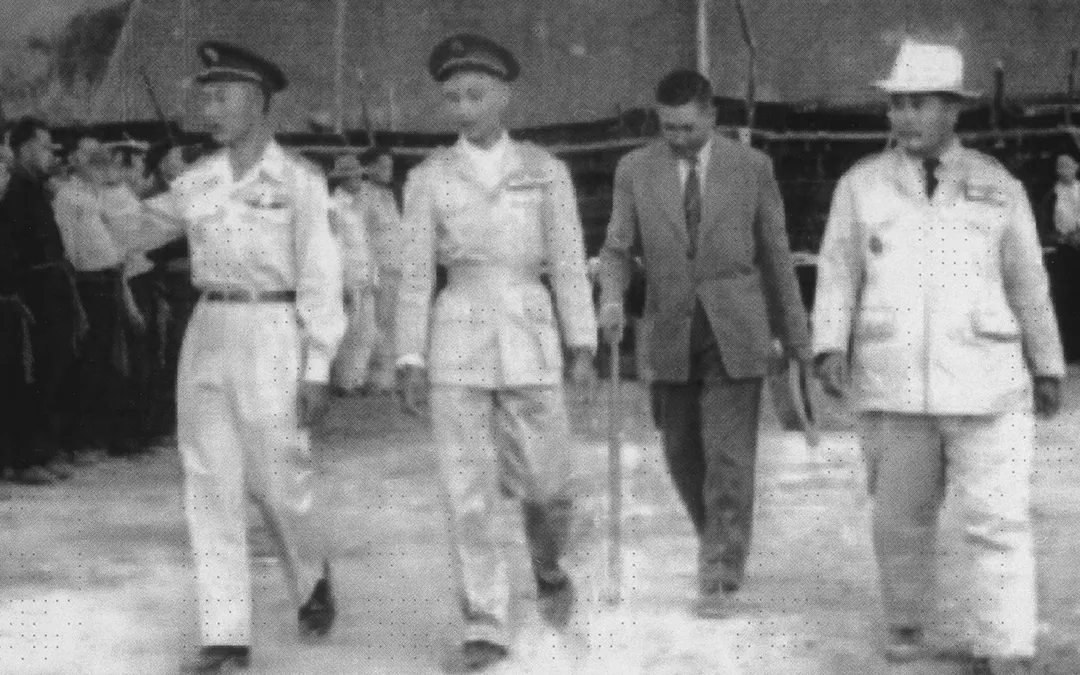
After the defeat of Japan in WW II, Japanese forces in Indochina surrendered, and nationalist movements rose to resist the return of French colonialism. In Laos, three brother princes, Phetsarath, Souvanna Phouma, and Souphanouvong, headed the Lao Issara (Free Laos) movement, which demanded full Lao independence.
Lo Fay Dang, Touby Lyfoung’s uncle on his mother’s side and one-time competitor for the title of Tasseng of Keng Khuai, immediately joined the Lao Issara. Although, Touby Lyfoung, along with King Sisavang Vong, felt that Laos needed a gradual transition to independence, under the protection of France. They felt that the achievement of an abrupt independence would leave Laos in a weak state, easy to be taken over by stronger neighbors such as Thailand or Vietnam.
In October 1945, the Lao Issara formed a new government and attempted to dismiss the king. Prince Souphanouvong was appointed minister of defense. He formed a new army with help from the Vietminh and Chinese army. However, the Vietminh had to fight their own war with the French and the Chinese army had to retreat back to China, leaving the Lao Issara army alone to fight the French.
In December 1945, the Lao Issara government in Vientiane sent an army to take over Luang Prabang and depose the king. It was supposed to join up with a Vietminh force coming from Vietnam. Before the two armies could join forces, Touby Lyfoung and the Hmong, Royalist Lao troops, and the French defeated the Vietminh force. Then they defeated the Lao Issara force, saving Luang Prabang and the king.
By April 1946, the French had retaken control of Vientiane and Luang Prabang, and the Lao Issara had fled to exile in Thailand. In 1949, the Lao Issara split between Communists and non-Communists, and it was disbanded. The Communist faction, under Prince Souphanouvong, became part of the Pathet Lao (Lao Nation), close allies with the Vietminh of North Vietnam.
The Pathet Lao was a subsidiary of the Vietminh. Its army was trained, armed, and led by North Vietnamese army officers. It fought side by side with North Vietnamese soldiers. In 1953, the French was defeated at Dien Bien Phu. Pathet Lao and Vietminh forces started moving into Laos to fight the French and Royal Lao government. These forces took control of eastern Laos and gained a foothold in the country.
In the Geneva Accord of 1954, foreign forces were required to leave Laos, but the Vietminh never did. In 1957, a coalition government was formed, including the Pathet Lao, but it fell apart in 1959. For the next decade and a half, the Vietminh and Pathet Lao would go on to sign two more Geneva Agreements that they would break and the Pathet Lao would join two more failed Laotian coalition governments. Laos was too important for the Vietminh to let go, and the Pathet Lao was not interested in sharing the governing of Laos with anyone else.
SOURCE:
Lyfoung, Touby with Dr. Touxa Lyfoung. Touby Lyfoung: An authentic account of the life of a Hmong man in the troubled land of Laos.